
By Rina Louw, MSocSc Clinical Social Worker • Jungian Sandplay Therapist
Sand & Clay Therapy Centre (Secunda)
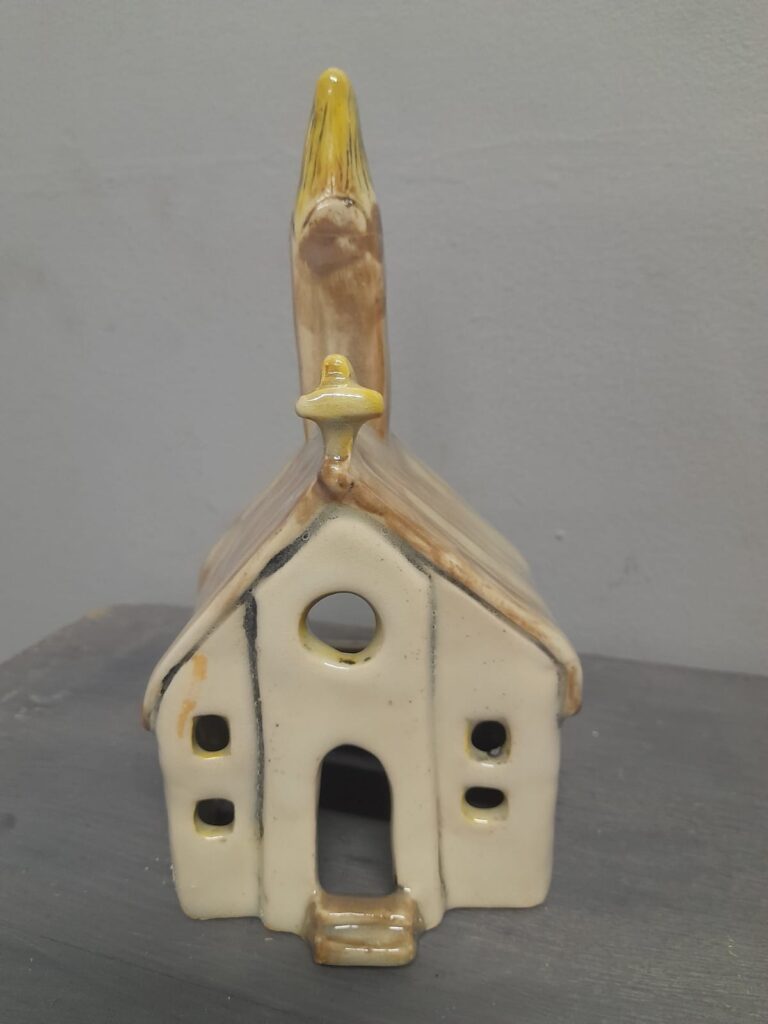
In Jungian Sandplay, children and adults create scenes in a tray of sand using miniature figures. Without needing to explain themselves, the psyche speaks in image and symbol. One figure that often invites curiosity is the church/chapel. Below is a grounded way to understand its symbolic potentials—without turning it into a fixed “meaning.”
1) Sacred Space (Temenos)
In Jung’s language, a sacred or protected space is called a temenos—a container where something deeper can be met safely. In Sandplay, a church/chapel can symbolise an inner sanctuary: a place of reverence, quiet, prayer, or contact with what feels larger than the everyday self. It may point to a longing for safety, order, or a trusted holding environment.
In children’s trays this may look like:
- The church placed centrally = the sacred as an organising centre
- Tucked in a corner = a private inner refuge
- Surrounded by fence/trees = protecting what is precious
Therapist stance: notice the placement and protection around the figure; avoid interpreting content to the child.
2) Integration of Opposites
Jungian work invites the meeting of opposites (inner/outer, spirit/matter, masculine/feminine). A church can symbolise a meeting place where tensions are held until a new balance emerges—much like a ritual space that blesses change.
In trays: bridges, paths or doorways linking the church to other areas can show how the psyche is attempting connection between divided parts.
3) Archetypal Images & Collective Memory
Crosses, altars, bells, stained glass—these are archetypal motifs that live in the collective psyche. When they appear in Sandplay, the scene may be drawing on universal patterns of meaning (belonging, forgiveness, awe, sacrifice, celebration).
Clinically: we note which motifs cluster together (e.g., light, candles, water, tree), the tone (solemn/joyful), and the distance from other figures.
4) Journey & Transformation (Individuation)
Rituals of entry, commitment, blessing, grief, and celebration often happen in churches. In Jungian terms this can mirror the individuation journey—crossing thresholds, letting go, and becoming more whole.
In trays: doors, steps, bridges, or processions can indicate transition; graves or memorials may signal mourning or meaning-making.
5) Collective Identity & Belonging
Churches are also community symbols—places where we are seen, named, and held by shared values. In Sandplay, a church might reflect a yearning for belonging, family/cultural identity, or the tensions that sometimes accompany them.
Watch for: crowds vs. solitude, open doors vs. closed, welcome vs. exclusion scenes.
For Therapists (Process Notes)
- Track placement (centre/edge), boundaries (walls/fences), and symbolic distance to power or threat figures.
- Hold the non-interpretive stance with children; use meaning hypotheses later in supervision/notes.
- Observe repetition vs. transformation across sessions (doors opening, more light, paths forming).
A Kind Word on Meaning
Symbols in Sandplay are alive—their meaning grows from the whole scene, the sequence of trays, and the child’s process over time. A church can be sanctuary, community, grief, hope, threshold, duty, or all of these at once. We witness, we do not impose.
Closing
I’m curious to see how this handmade church will be used by the children and adults I accompany in Sandplay. If you have questions—or would like guidance for your child—feel free to reach out.
Contact: info@rinalouwclinical.co.za • Sand & Clay Therapy Centre (Secunda)
My Sandplay Therapy Room