
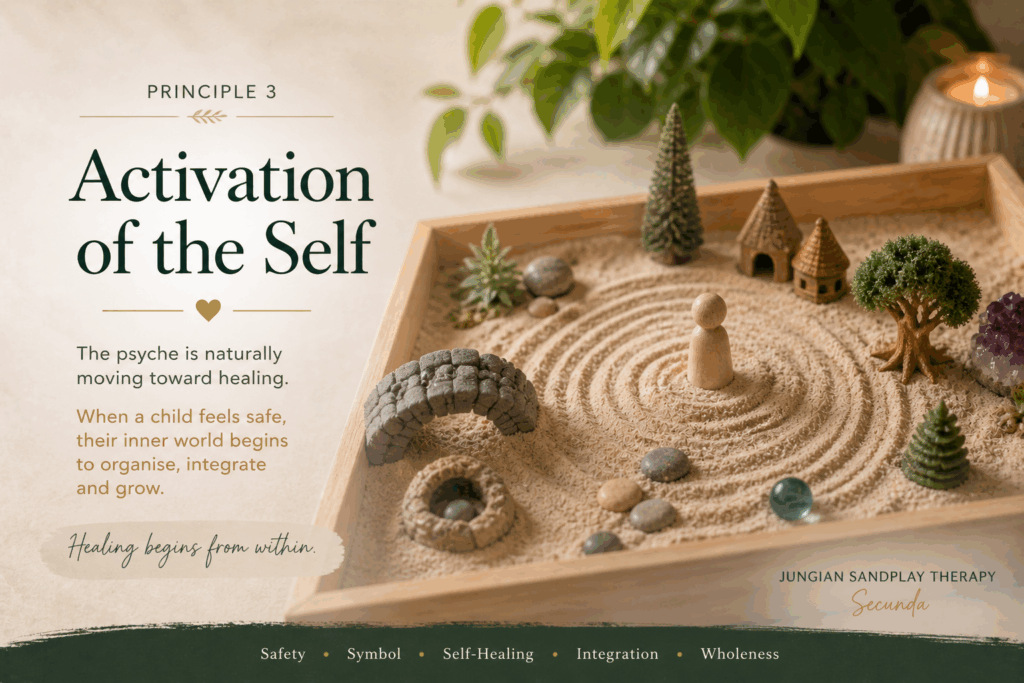
How Healing Begins from Within in Jungian Sandplay Therapy
In Jungian Sandplay Therapy, one of the most important principles is this:
The child is not broken.
The psyche is already trying to heal.
This idea comes from the work of Carl Gustav Jung and was deeply trusted in the clinical work of Dora Kalff.
At the centre of Jungian psychology is the concept of the Self — the inner organising force that moves a person toward balance, integration, and wholeness.
In Sandplay Therapy, we begin to see this process unfold naturally.
https://rinalouwclinical.co.za/10-core-principles-jungian-sandplay-therapy/
🌿 What Is the “Self”?
In everyday language, we often think of the self as personality or identity.
But in Jungian psychology, the Self is something much deeper.
It is:
- the inner centre of the psyche
- the part that holds the potential for healing
- the force that moves a person toward wholeness
The Self does not need to be taught or created.
It is already there.
What it needs is the right conditions to emerge.
🌿 How the Self Appears in Sandplay
In Sandplay Therapy, the activation of the Self is not explained to the child.
It is seen over time in the trays.
A child may begin with:
- scattered figures
- chaos or conflict
- disconnected scenes
- themes of danger or vulnerability
Without being directed, something begins to shift.
Gradually, we may see:
- more organisation in the tray
- the appearance of protective figures
- clearer boundaries
- a central figure or theme emerging
- movement from chaos toward structure
This change is not instructed by the therapist.
It is the psyche reorganising itself.
This is the activation of the Self.
🌿 A Practical Understanding for Parents
Parents often feel pressure to “fix” behaviour:
- “Why is my child acting like this?”
- “How do I stop this behaviour?”
- “What should I do differently?”
These questions are understandable.
But behaviour is often only the surface.
Underneath, something deeper is happening.
The principle of the Self invites a different understanding:
👉 Your child’s behaviour may be part of an inner process trying to organise itself
👉 Your child may not yet have the words — but the psyche is still working
This shifts the question from:
❌ “How do I stop this?”
to
✔ “What might this be showing me?”
🌿 The Role of the Therapist
In Jungian Sandplay Therapy, the therapist does not direct the child toward healing.
Instead, the therapist:
- creates a free and protected space
- remains calm and regulated
- does not interrupt the symbolic process
- trusts the child’s inner world
This can feel counterintuitive.
But it is this non-directive presence that allows the Self to emerge.
🌿 The Link with Emotional Regulation
Modern neuroscience, including the work of Dan Siegel, supports this understanding.
When a child feels safe:
- the nervous system begins to settle
- emotional states become more regulated
- different parts of the brain begin to integrate
In Sandplay:
- the body
- the emotions
- the symbolic images
begin to connect.
This supports:
- emotional regulation
- behavioural stability
- a stronger sense of self
🌿 Why This Principle Matters
When we understand the activation of the Self, something shifts in how we see children.
https://rinalouwclinical.co.za/symbolic-nonverbal-process-jungian-sandplay-case-study/: 🌱 Principle 3: The Activation of the SelfInstead of seeing:
❌ a “difficult child”
❌ a “disrespectful child”
we begin to see:
✔ a child in process
✔ a child trying to organise inner experience
✔ a child moving toward healing
🌿 Closing Reflection
In Jungian Sandplay Therapy, healing is not something we impose.
It is something we allow.
When a child is given:
- safety
- space
- freedom to express
the psyche begins to move.
Quietly.
Naturally.
Powerfully.
And in that movement, the Self begins to emerge.
📍 Jungian Sandplay Therapy in Secunda
If your child struggles with:
- emotional outbursts
- anxiety
- withdrawal
- behaviour that is difficult to understand
Jungian Sandplay Therapy offers a gentle, depth-oriented approach.
📍 Secunda
🌿 Jungian Sandplay Therapy
📩 Appointments available
I